.png "Operation Jump")
How Much Space Do You Need for a Bounce House?
You've decided to rent a bounce house for your kid's birthday party in the greater Austin area, and now you're staring at your backyard wondering if it's actually going to fit. You know the bounce house dimensions, but what about the space around it? The clearance overhead? Whether the delivery crew can even get it back there?
These are the questions that pop up after you've already picked out the perfect inflatable. Let's walk through exactly how to measure your space, what clearances matter, and how to avoid the "oops, it doesn't fit" moment on party day.
What You'll Learn
- The basic space formula for any bounce house
- Side, overhead, and perimeter clearance rules
- How to measure your yard step-by-step
- Access path requirements and gate width
- Space requirements for common bounce house sizes
- Dealing with trees, fences, slopes, and other obstacles
- Frequently asked questions
Planning Your First Party?
You're browsing bounce houses online and loving the options, but you're not sure what will actually fit in your yard. You need the space basics before you commit to a rental.
Dealing with a Tight Backyard?
You have a smaller yard, close fences, or low-hanging tree branches. You're wondering what the absolute minimum space is and whether you have enough wiggle room.
Already Booked and Measuring?
The rental is confirmed and now you're doing the final check. You want to make sure your measurements are right and that delivery day goes smoothly.
The Basic Space Formula Every Parent Should Know
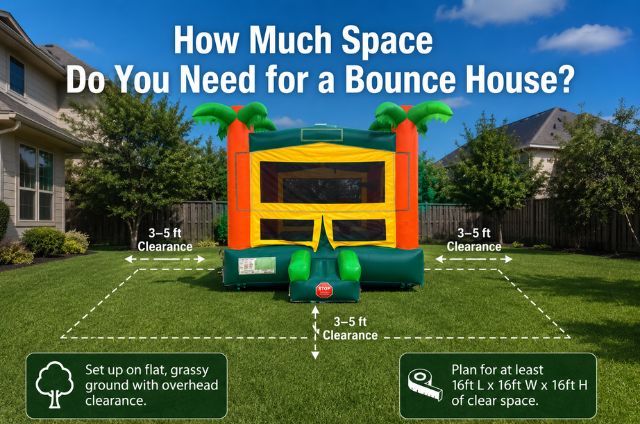
Here's the simple rule: take the bounce house dimensions and add 3 feet on every side. That extra space isn't just a nice-to-have—it's for stakes, safety clearance, and making sure kids don't bounce into a fence or tree.
So if you're renting a bounce house that's 13 feet wide by 13 feet deep, you actually need a setup area that's roughly 19 feet by 19 feet. The inflatable itself takes up the center, and the surrounding space gives you room for secure anchoring and safe play.
Quick Math: Bounce house width + 6 feet = total width needed. Bounce house depth + 6 feet = total depth needed. That's your minimum setup footprint.
Most residential bounce houses for backyard parties fall between 13x13 feet and 15x15 feet. Combination units with slides attached can stretch to 20 feet long or more. Water slides are even larger, often requiring 30+ feet of length.
Understanding Clearance: Side, Overhead, and Perimeter
Space requirements aren't just about the footprint. You also need to think about what's above the bounce house and how close it can safely sit to other structures.
Side Clearance (Horizontal Space)
The 3-foot buffer around all sides serves multiple purposes. It gives kids a safer landing zone if they tumble out the entrance. It prevents the inflatable from rubbing against fences or walls, which can cause wear or punctures. And it provides enough room for the setup crew to properly stake the unit and position the blower.
Fences and walls: Keep the bounce house at least 5 feet away if possible. This gives you extra breathing room and keeps kids from bouncing right up against hard surfaces.
Trees and landscaping: Same rule applies. You don't want tree roots interfering with stakes, and you definitely don't want kids bouncing into low branches.
Overhead Clearance (Vertical Space)
A bounce house is typically 10-15 feet tall when fully inflated, depending on the style. But you need more clearance than just the height of the unit itself. The blower exhausts air upward, and you want proper airflow to prevent overheating.
Minimum overhead clearance: The height of the bounce house plus 4-5 feet. So a 12-foot tall inflatable needs about 17 feet of open vertical space.
Check for low-hanging tree branches, patio covers, pergolas, or power lines. Power lines are an absolute no-go zone—never set up a bounce house anywhere near electrical lines.
Warning: Power lines are a serious safety hazard. If your yard has low power lines running through it, choose a different setup location or consider a smaller inflatable that can be positioned safely away from them.
Staking and Anchoring Space
Bounce houses are anchored with stakes driven into the ground at angles, extending outward from each corner. Stakes are usually placed about 2-3 feet from the edge of the inflatable, which is why that perimeter clearance matters.
If you're setting up on a hard surface like a driveway or patio, water barrels or sandbags replace stakes. These take up slightly less room but still need stable, flat placement around the perimeter.
How to Measure Your Yard Step-by-Step
You don't need to be a contractor to measure your yard properly. Grab a tape measure, a notepad, and maybe a second person to hold the other end of the tape.
Measure the Setup Area
Stand where you plan to position the bounce house. Measure the length and width of the open space. Write down both dimensions.
Add Clearance Buffer
Add 6 feet to both dimensions (3 feet on each side). This is your true available space for a bounce house footprint.
Check Overhead Clearance
Look up. Measure or estimate the height from ground to the lowest obstacle above (tree branch, roof edge, patio cover). You need at least 17 feet clear.
Check Distance to Obstacles
Measure from your setup spot to the nearest fence, wall, tree, or structure. You want at least 5 feet of buffer to any solid obstacle.
Evaluate Ground Conditions
Walk the setup area. Is it level? Any major slopes? Soft dirt or firm grass? Sprinkler heads or hidden obstacles? Note anything that might affect setup.
Confirm Power Access
Locate the nearest outdoor outlet. Standard blowers need a dedicated 15-amp outlet within 50-75 feet. Extension cords can cover some distance, but you need a power source.
Pro Tip: Take a photo of your yard from multiple angles and send it to the rental company when you book. They've seen thousands of setups and can spot potential issues you might miss.
Access Path Requirements: Can the Bounce House Even Get There?
Your backyard might have plenty of space, but if the delivery crew can't get the bounce house back there, you've got a problem. Bounce houses are delivered deflated and folded on a rolling cart, but that cart still needs clearance to navigate your yard.
Gate Width and Path Clearance
Most residential gates are 36 to 48 inches wide. Delivery carts are typically 30-36 inches wide, so a standard gate usually works fine. The tight spots are often not the gate itself but the path leading to it—corners where fences meet houses, narrow side yards, or landscaping that encroaches on the walkway.
Minimum access width: 36 inches clear, measured at the narrowest point. Walk the entire path from your driveway to the backyard and measure any spots that look tight.
If your side yard is narrower than 36 inches or blocked by AC units, trash cans, or planters, you'll need to clear a path before delivery. Most crews are happy to help navigate tricky spots, but they can't squeeze through a 24-inch gap.
Front Yard and Driveway Setups
Can't get to the backyard? No problem. Many parties happen in front yards or driveways, especially in Austin-area neighborhoods with smaller lots or limited side-yard access. Front yard setups are common in Pflugerville and Cedar Park, where lot layouts often favor front access.
Driveway setups work great as long as you're okay with cars being parked on the street during the party. Just make sure the driveway is level and free of major cracks or uneven sections that could affect stability.
What If Access Is Impossible?
If your backyard is completely landlocked with no viable access, you have two options: set up in the front yard, or rent a smaller inflatable that can be carried through tight spaces. Some compact bounce houses can be hand-carried in sections, but this isn't common for standard party inflatables.
Talk to the rental company during booking. Explain your access situation and ask if the unit you're interested in can navigate your space. They'll know from experience what's feasible.
Space Requirements for Common Bounce House Sizes
Here's a quick reference guide for the most popular bounce house styles and the real-world space they require. These numbers include the recommended clearance buffer.
13×13 Foot Unit
Setup Space Needed: 19×19 feet
Height: 12-14 feet
Best For: Smaller backyards, younger kids (ages 3-8), standard birthday parties
15×15 Foot Unit with Slide
Setup Space Needed: 21×21 feet
Height: 13-15 feet
Best For: Medium backyards, mixed-age groups, parties with 10-20 kids
Water Slide Combo
Setup Space Needed: 20×35 feet
Height: 15-18 feet
Best For: Larger yards, summer parties, older kids and teens
35-40 Foot Obstacle
Setup Space Needed: 15×45 feet
Height: 10-12 feet
Best For: Large events, school fairs, competitive play
These are typical dimensions. Actual sizes vary by manufacturer and model, so always check the specific unit details when you're browsing rentals. The rental listing should provide exact dimensions.
Dealing with Obstacles: Trees, Fences, Slopes, and More
Most backyards aren't perfectly flat and obstacle-free. Here's how to work around the common challenges Texas yards present.
Trees and Overhanging Branches
Trees provide great shade, but they can limit where you place a bounce house. Low branches are a problem both for overhead clearance and because they can snag on the inflatable during setup or deflation.
What to do: Position the bounce house away from the tree canopy entirely, or trim low-hanging branches before the party. If the tree is providing shade you want to keep, choose a smaller bounce house that fits safely underneath.
Tree roots can also make staking difficult. If the ground under a tree is packed with roots, you may need to position the unit a few feet away where stakes can penetrate properly.
Sloped or Uneven Ground
Bounce houses need to be set up on relatively level ground. A slight slope is usually fine, but a pronounced incline creates safety issues—kids will naturally slide toward the low end, and the inflatable can shift or become unstable.
Rule of thumb: If you can notice the slope just by standing in the area, it's probably too steep. Walk the setup location and check for any noticeable tilt. If it feels flat underfoot, you're good.
Some Austin-area homes, especially in West Lake Hills and parts of Cedar Park, have terraced or sloped yards. In these cases, you might need to position the bounce house on the flattest tier or consider a driveway setup instead.
Sprinkler Heads and Underground Utilities
Stakes get driven 12-18 inches into the ground. That means you need to know what's under your lawn. Sprinkler heads are the most common obstacle, but underground utilities, invisible dog fences, and drainage lines can also be in the way.
What to do: Walk the setup area and mark any visible sprinkler heads, valve boxes, or utility covers. Let the delivery crew know where these are so they can adjust stake placement. If the area is riddled with obstacles, you might need to shift the bounce house a few feet in any direction.
If you're setting up on a patio or driveway, this isn't an issue—water barrels or sandbags are used instead of stakes.
Pools, Play Equipment, and Other Structures
Keep bounce houses well away from pools, trampolines, swing sets, and other play structures. You don't want kids running from one activity straight into another without supervision, and you definitely don't want a bounce house positioned where a kid could tumble out and land in a pool.
Minimum distance from pools: 10 feet, preferably more. Same rule for other hard or hazardous structures.
🚩 Red Flags: Don't Set Up Here
- Within 15 feet of power lines
- On a pronounced slope or hill
- Directly under low tree branches
- Next to a busy street with no barrier
- Near a pool without adequate separation
- On ground with heavy root systems preventing staking
✓ Ideal Setup Locations
- Flat, open area of lawn or grass
- Level driveway or patio with hard surface
- Backyard with 5+ feet clearance to fences
- Shaded area without low-hanging branches
- Front yard with good visibility from the house
- Area with easy access to outdoor power outlet
What Happens If Your Space Is Slightly Tight?
Let's say you measured your yard and you're almost there but not quite at the recommended clearances. Maybe you have 18 feet instead of 19, or your side clearance is 4 feet instead of 5. Is that a dealbreaker?
Usually not. The 3-foot perimeter guideline is a best practice, not a hard rule. Setup crews work with real-world conditions all the time and can often make small adjustments. The key is to be honest with the rental company about your space when you book.
If your space is borderline, mention it during booking. Send photos. Ask if the specific unit you want will work. Most rental companies would rather help you find a unit that fits than show up on party day and discover it won't work.
You can also ask about slightly smaller alternatives. A 13x13 bounce house instead of a 15x15 might give you the breathing room you need without sacrificing the fun.
Special Considerations for Austin-Area Yards
If you're planning an event in Hutto, Pflugerville, Cedar Park, West Lake Hills, or Austin proper, here are a few local factors to keep in mind.
Lot Sizes and Layout Trends
Newer subdivisions in Hutto and Pflugerville often have smaller backyards but good side-yard access. Homes built in the last 10-15 years typically have narrower lots with less backyard depth, which means you might be working with a 25×30 foot space rather than the sprawling yards common in older neighborhoods.
Cedar Park and parts of West Lake Hills have more variable lot sizes, with some homes on generous lots and others on steeper, terraced properties. If you're in a hillier area, front yard or driveway setups are often the easiest solution.
Heat and Shade Considerations
Texas heat is no joke, especially from May through September. If you're planning a daytime party in the summer, shade becomes a major factor. Position the bounce house under a tree canopy if clearance allows, or set up a pop-up canopy nearby for parents and non-bouncing kids.
Bounce houses heat up quickly in direct sun, and kids get exhausted faster in the heat. Shade makes the experience more comfortable and extends how long kids can actively play.
HOA and Community Rules
Some HOAs have rules about inflatables, especially regarding front yard setups or how long they can remain inflated. Most don't care for a single-day event, but it's worth checking if you live in a community with strict aesthetic guidelines.
If your HOA requires advance notice for parties or has restrictions on street parking, plan accordingly. The last thing you want is a compliance issue on party day.
Frequently Asked Questions
How much clearance does a bounce house need? +
A bounce house needs at least 3 feet of clearance on all sides for safe setup and operation. Vertically, you need the height of the inflatable plus an additional 4-5 feet for proper airflow and blower positioning. This means a 12-foot tall bounce house requires about 17 feet of overhead clearance when accounting for the blower exhaust and safety margin.
How far should a bounce house be from a fence? +
Position your bounce house at least 5 feet away from fences, walls, trees, or other structures. This distance provides safe clearance for kids who might bounce near the edges, prevents the inflatable from rubbing against surfaces that could cause wear or punctures, and gives setup crews room to properly stake and secure the unit.
How do I measure my yard for a bounce house? +
Start by measuring the length and width of your intended setup area using a tape measure or measuring wheel. Add 6 feet to both dimensions to account for clearance and stakes. Check for overhead obstacles like tree branches or power lines. Finally, walk the path from your driveway or access point to the setup location, measuring the narrowest points to ensure delivery clearance.
Can a bounce house fit through a backyard gate? +
Most residential gates are 36-48 inches wide. Bounce houses are delivered deflated and folded on carts that are typically 30-36 inches wide, so standard gates usually work fine. However, you also need to account for corners, landscaping, and any narrowing in the path. Measure your gate width and the entire path to your backyard, noting any spots narrower than 36 inches.
Can you set up a bounce house on a slope? +
Bounce houses need relatively level ground. A slight, barely noticeable slope is usually okay, but a pronounced incline creates safety issues. If you can feel the slope when standing in the area, it's probably too steep. Kids will naturally slide toward the low end, and the inflatable can shift or become unstable on uneven ground.
What if my yard has sprinkler heads in the setup area? +
Sprinkler heads can interfere with stake placement but usually aren't a dealbreaker. Walk the setup area and mark any visible sprinkler heads or valve boxes. Let the delivery crew know where these are located so they can adjust stake placement accordingly. Most crews can work around a few sprinkler heads without issues.
How close can a bounce house be to a pool? +
Keep bounce houses at least 10 feet away from pools, preferably more. You don't want kids running from the bounce house and accidentally tumbling into the pool, and you need clear separation between different activity zones for proper supervision. The same distance rule applies to other hard or hazardous structures.
Can I set up a bounce house in my front yard? +
Absolutely. Front yard setups are common, especially when backyard access is limited or the front yard has better space. Just make sure the area is visible from the house for supervision, away from busy streets, and that you're okay with guests parking on the street during the party. Many families in Pflugerville and Cedar Park use front yards regularly for events.
Final Thoughts: Measure Twice, Book Once
Getting the space right doesn't require perfection—it just requires a little attention to detail. Walk your yard, measure the key dimensions, and be honest with your rental company about what you're working with.
Most space concerns are easily solved with a small adjustment—shifting the unit a few feet, choosing a slightly smaller bounce house, or setting up in the front yard instead of the back. The key is knowing your constraints before booking, not discovering them on party day.
If you've measured your space and you're still not sure if a particular bounce house will fit, just ask. Rental companies deal with tight spaces, tricky access paths, and creative solutions every single day. They'd rather help you get it right the first time than have to troubleshoot on delivery.
Need help figuring out what size bounce house works for your yard? Check out our complete guide to bounce house rentals or browse available bounce houses by size and style.
Ready to Book Your Bounce House?
Find the perfect bounce house for your space and party size. No pressure, no pitch—just easy online booking for Hutto, Pflugerville, Cedar Park, West Lake Hills, and Austin.
Find Your Party DateQuestions about your space? Call 512-900-3499 and we'll help you figure it out.