.png "Operation Jump")
Bounce House vs. Inflatable Obstacle Course: Which Fits Your Event?
You're planning a birthday party, school event, or church festival, and you've narrowed it down to two options: a classic bounce house or an inflatable obstacle course. Both get kids moving. Both create memorable moments. But they serve completely different purposes depending on your guest list, space, and how you want the day to flow.
This guide walks you through the real-world differences — not just features, but how each choice affects your event. You'll know which one fits your situation by the time you finish reading.
What's Inside This Guide
- → Which Type of Event Are You Planning?
- → How Bounce Houses and Obstacle Courses Work
- → Which Works Better for Different Age Groups
- → Space Requirements and Setup Realities
- → Handling Small vs. Large Groups
- → What Works Best for Schools, Churches, and Birthdays
- → Cost and Rental Considerations
- → Quick Decision Map
- → Common Questions Answered
Which Type of Event Are You Planning?
Before diving into features and logistics, figure out which scenario sounds most like your event. The right choice becomes obvious once you recognize your situation.
Free Play Birthday Party
Kids arriving in waves over 2-3 hours. Mixed ages (toddlers through tweens). You want something that keeps everyone entertained without constant supervision or organizing activities.
→ Lean toward: Bounce House
Organized School Event
Field day, fundraiser, or festival with structured activities. You need something that creates natural competition, handles scheduled rotations, and keeps older kids engaged through challenges.
→ Lean toward: Obstacle Course
Big Crowd Event
Church festival, community celebration, or large gathering with 50+ kids. You need maximum throughput so lines don't get out of control, and you want something that handles continuous use without bottlenecks.
→ Lean toward: Large Bounce House or Multiple Units
How Bounce Houses and Obstacle Courses Work
The difference isn't just size. It's how kids interact with each one and how that affects your event flow.
Bounce Houses: Open Play Zones
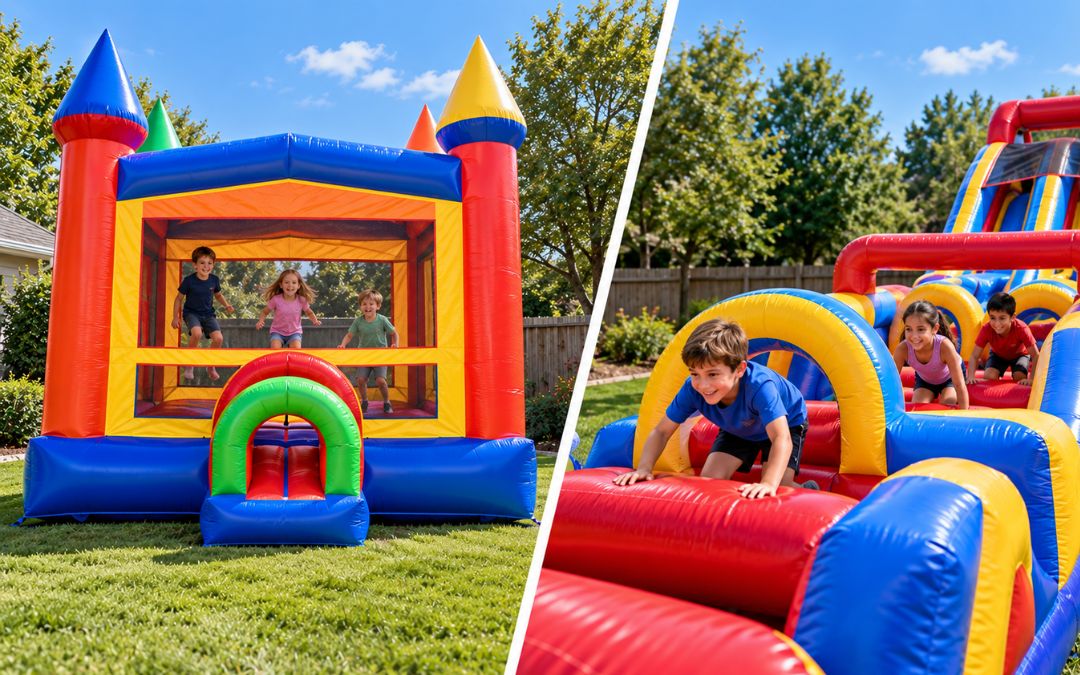
A bounce house is an open inflatable play area where kids jump, play, and burn energy without following a specific path or completing a challenge. Think of it as a trampoline with walls.
- Kids enter and exit freely — no set beginning or end
- Multiple kids jump simultaneously — typically 8-12 at once depending on size
- Works for mixed ages — a 3-year-old and a 9-year-old can both have fun
- Self-directed play — kids create their own games and entertainment
- Sessions vary naturally — some kids stay 20 minutes, others bounce for 2 minutes and leave
Real-world note: Bounce houses excel at unstructured events where kids need something to do between pizza, cake, and other activities. Parents appreciate not having to organize games or manage turn-taking.
Obstacle Courses: Competitive Challenges
An inflatable obstacle course is a linear challenge with a start and finish. Kids climb, crawl, squeeze through barriers, and race to the end — either competing against friends or beating their own time.
- Defined path from start to finish — structured activity flow
- 2-4 kids compete at once — side-by-side racing lanes
- Better for older kids — challenges require coordination and physical effort
- Creates natural competition — kids race each other or try to beat their time
- Faster turnover — most runs take 30-90 seconds, then the next group goes
Real-world note: Obstacle courses work beautifully at organized events because they create built-in entertainment value. Kids naturally form lines, cheer each other on, and want to go multiple times to improve their performance.
Which Works Better for Different Age Groups
Age matters more than you'd think. What thrills a 5-year-old bores a 10-year-old, and what challenges a tween intimidates a toddler.
Winner: Bounce House
Toddlers and preschoolers love simple jumping. They don't need competition or structured challenges — they just want to bounce, fall safely, and giggle.
Why it works: Low entry barriers (literally). Soft landings. No complex movements required. Parents can step inside if needed.
Obstacle courses are too physically demanding for this age group. Most can't navigate the climbing walls, squeeze tunnels, or pop-up barriers effectively.
Either Works
This is the sweet spot age where both options deliver. Early elementary kids have the coordination for obstacle courses but still enjoy bouncing freely.
Choose based on the event format: Free play party? Bounce house. Structured field day? Obstacle course. Want maximum flexibility? A combo unit with a slide bridges both worlds.
Winner: Obstacle Course
Tweens and teens outgrow basic bounce houses quickly. They feel silly jumping in an open play area designed for younger kids. But racing through an obstacle course? That's competitive, challenging, and socially acceptable.
Why it works: Physical challenge. Built-in competition. The ability to race friends and actually accomplish something beyond "we jumped."
Standard bounce houses lose this age group in under 10 minutes.
⚠️ Mixed-age parties: If you have toddlers and tweens at the same event, consider renting both (if budget and space allow) or choose a large combo bounce house with a slide. That setup keeps younger kids bouncing while older kids focus on the slide element.
Space Requirements and Setup Realities
This is where a lot of people hit a surprise roadblock. You love the idea of an obstacle course — until you realize it won't fit in your yard.
Standard Bounce House Space Needs
- Footprint: 13x13 to 15x15 feet for most units
- Total space needed: Add 3-5 feet on all sides for stakes and clearance
- Height clearance: 12-14 feet (matters for tree branches and patio covers)
- Surface: Grass, concrete, or asphalt (we bring tarps for hard surfaces)
- Access: Standard gate width works fine
Where they fit easily: Most backyards, driveways, parking lots, parks, and church gyms (if indoor setup).
Obstacle Course Space Needs
- Footprint: 30-40 feet long by 10-12 feet wide
- Total space needed: Add 5 feet on all sides — you need a clear running path
- Height clearance: 12-15 feet
- Surface: Grass or large open paved areas work best
- Access: Wider gate or side-yard access required for delivery
Where they work best: School fields, large backyards, parks, church parking lots. Tight residential yards often can't accommodate the length.
✓ You Have the Space If:
- You can walk 40 big steps in a straight line
- No trees, fences, or structures block the path
- There's clearance for kids to line up at the start
- Delivery crew can wheel it to the setup spot
✗ Go With Bounce House If:
- Your yard is narrow or L-shaped
- You're working with a driveway or small side yard
- There's no long clear run without obstacles
- Access requires tight gates or winding paths
Pro tip: When you contact us, we'll ask about your space and help you choose what actually fits. We've seen plenty of customers fall in love with an obstacle course online only to discover their yard won't accommodate it. Measuring before you decide saves disappointment.
Handling Small vs. Large Groups
How many kids will actually be jumping at once? Not your total guest list — the number who'll want to use it at the same time. That's what determines whether you'll have happy kids or frustrated lines.
Small Parties (Under 20 Kids)
Either option works perfectly. With smaller groups, wait times stay minimal whether kids are bouncing freely or racing through an obstacle course.
Choose based on age and event style rather than capacity concerns.
Medium Events (20-40 Kids)
Bounce houses handle this better for continuous play. You can have 10-12 kids bouncing simultaneously while others rotate in naturally. No one manages a line — kids just flow in and out.
Obstacle courses work if the event is structured. You're running heats, organizing races, or using it as one station in a rotation. But if kids just want to use it randomly throughout the party, lines form fast because only 2-4 can go at once.
Large Events (40+ Kids)
You need high-capacity solutions. A single obstacle course creates bottlenecks unless you're running it like a timed station with scheduled rotations.
Better options for big crowds:
- Large bounce houses (15x15 or bigger) that fit 12-15 kids
- Multiple smaller bounce houses in different areas
- Combo units with both bouncing and sliding elements
- Two obstacle courses if you have the space and want races all day
⚠️ Watch out for this: We've seen church festivals rent a single obstacle course for 100+ kids expecting it to entertain everyone. It doesn't. The math doesn't work. Each run takes 60-90 seconds, so even running continuously, you're looking at long waits. For crowds that size, you need multiple inflatables or large-capacity options.
What Works Best for Schools, Churches, and Birthdays
Different events have different flows. What works for a backyard birthday falls apart at a field day.
🎂 Birthday Parties
Best choice: Bounce House
Birthday parties flow in waves — cake time, present time, free play. Kids wander in and out of activities without structure. A bounce house accommodates that perfectly.
Exception: If the birthday child is 9+ and specifically wants competitive races with friends, go obstacle course. Just know you're committing to organizing heats.
🏫 School Field Days
Best choice: Obstacle Course
Field days thrive on competition and structured rotations. Obstacle courses create natural heats, time trials, and relay race opportunities. Teachers can organize brackets or just run timed rotations.
Plus, older elementary students actually stay engaged instead of feeling like the activity is beneath them.
⛪ Church Events & Festivals
Best choice: Large Bounce House or Multiple Units
Church festivals draw massive mixed-age crowds — toddlers, elementary kids, tweens, all at once. You need high-throughput options that keep lines moving.
A large bounce house handles volume better than a single obstacle course. If budget allows, adding an obstacle course as a second attraction creates variety without overwhelming capacity.
🏢 Company Family Days
Best choice: One of Each
Corporate family events benefit from having both. Younger kids gravitate to the bounce house. Older kids and competitive adults love the obstacle course. It splits the crowd naturally and gives families options.
🏘️ Neighborhood Block Parties
Best choice: Bounce House
Block parties are casual, all-day affairs with kids coming and going. No one wants to organize heats or manage competitive rotations. A bounce house lets kids play freely while parents socialize.
🎓 Graduation Parties
Best choice: Obstacle Course
High school and college graduation parties often include younger siblings and kids of guests. An obstacle course feels age-appropriate for teens and adults who want to compete while still entertaining younger attendees.
Cost and Rental Considerations
Budget matters. Let's talk real numbers and what affects pricing around Hutto, Pflugerville, Cedar Park, and Austin.
General Pricing Patterns
Standard Bounce Houses
Typically the most affordable option. Standard 13x13 or 15x15 bounce houses cost less to rent because they're simpler, lighter, and easier to transport and set up.
Good for budget-conscious events where you want quality entertainment without stretching finances.
Obstacle Courses
Generally cost more. They're larger, heavier, require more setup labor, and often need additional blowers. The complexity and size drives prices up compared to basic bounce houses.
Worth it if you're planning a structured event where the competitive element is the main attraction.
Combo Units
Middle ground pricing. Combo bounce houses with slides cost more than basic units but less than full obstacle courses. They give you versatility — bouncing and sliding in one footprint.
Smart choice for mixed-age parties where you want variety without renting multiple pieces.
What Affects Your Final Cost
- Rental duration: Standard rentals cover 4-6 hours; longer events cost more
- Delivery location: Events in Hutto, Pflugerville, or Cedar Park may have different delivery fees than Austin proper
- Setup complexity: Difficult access, steep terrain, or special requests add to labor time
- Seasonal demand: Peak party season (spring/early summer) sometimes affects availability
- Add-ons: Tables, chairs, concessions, or multiple inflatables increase total cost
Booking tip: Reserve early for popular dates (weekends, holidays, end of school year). Prices don't change, but availability disappears fast. We've had customers disappointed when their first-choice inflatable was already booked for their date.
Quick Decision Map: Which One Should You Choose?
Still undecided? Use this quick reference to match your situation to the best option.
✓ Choose a Bounce House If:
- Most guests are under age 7
- You have limited space (small yard, driveway)
- It's a casual, free-play event
- You need to accommodate 20+ kids at once
- Budget is tight
- You want simple, self-directed entertainment
- Parents need to focus on other party tasks
✓ Choose an Obstacle Course If:
- Most guests are age 7+
- You have a large open space (30-40 feet clear)
- It's a structured event with organized activities
- You want competitive racing and challenges
- Group size is manageable (under 30 kids) or you're running heats
- Older kids need something engaging
- The event format supports taking turns
✓ Consider Both If:
- You have a wide age range (toddlers through teens)
- Space and budget allow for two rentals
- It's a large event (50+ attendees)
- You want to split crowds naturally
- The event runs several hours and needs sustained entertainment
🚩 Red flag: Don't choose an obstacle course just because it looks cooler in photos if you have toddlers, limited space, or huge crowds. The wow factor doesn't matter if it doesn't work for your actual event. Bounce houses aren't boring — they're strategic choices that keep kids entertained and parents stress-free.
Common Questions About Bounce Houses vs. Obstacle Courses
Which is better for older kids: bounce house or obstacle course?
Obstacle courses typically work better for older kids (7+) because they offer competitive challenges and physical activities that keep them engaged longer. Most traditional bounce houses feel too babyish for school-age kids, though combo units with slides can bridge the gap. If your guest list skews older, an obstacle course prevents the "I'm bored" complaints.
Which handles larger groups better: bounce house or obstacle course?
Bounce houses handle larger groups more efficiently because 8-12 kids can jump simultaneously. Obstacle courses entertain 2-4 kids at once in active competition, which means longer wait times at busy events. For crowds over 30 kids, you may need multiple obstacle courses or choose a large bounce house to keep everyone moving.
Do obstacle courses need more space than bounce houses?
Yes. Most obstacle courses measure 30-40 feet long and need a clear run with 3-5 feet of clearance on all sides. Standard bounce houses typically need 15x15 feet. If you're working with a smaller backyard or indoor space, a bounce house usually fits where an obstacle course won't.
Are obstacle courses better for school events?
Obstacle courses excel at school field days, fundraisers, and organized events because they create natural competition, engage mixed age groups, and keep kids moving through structured activities. They work especially well when you can run timed heats or relay races. Bounce houses work better for open play situations where kids come and go freely.
Can adults use obstacle courses?
Most obstacle courses have weight limits (check specific units), but yes — adults love them. We see parents racing at graduation parties, company events, and fundraisers all the time. Just make sure the rental company confirms weight capacity and knows adults will participate so they bring appropriately rated equipment.
What if it rains on my event day?
Light rain usually doesn't stop play — inflatables get wet and kids don't mind. Heavy storms or lightning shut things down for safety. Most rental companies have weather policies and rescheduling options. At Operation Jump, we work with you to find solutions when weather doesn't cooperate, whether that's rescheduling or adjusting setup plans.
How long does setup take?
Standard bounce houses take 15-20 minutes to set up and inflate. Obstacle courses take longer — typically 20-30 minutes — because of their size and complexity. We arrive before your event start time to ensure everything is ready when guests arrive. Just make sure someone is available to show us where to set up and provide electrical outlet access.
Do I need to provide electricity?
Yes. Both bounce houses and obstacle courses need continuous power to keep the blower running. We bring extension cords, but you'll need access to a standard outdoor outlet within about 100 feet of the setup location. If electricity isn't available, ask about generator rental options — we can help solve that problem.
Are bounce houses safe for toddlers?
Yes, when used properly. Keep toddlers separate from much older, bigger kids who might accidentally knock them over while jumping. Some parents dedicate toddler-only bounce time or supervise closely during mixed play. Inflatables have soft surfaces and mesh walls to keep little ones contained safely. Just use common sense about mixing very different ages and sizes.
Ready to Book Your Bounce House or Obstacle Course?
We'll help you choose what actually fits your space, guest list, and event style. No pressure, no pitch — just honest answers from people who've set up hundreds of these things across Hutto, Pflugerville, Cedar Park, and Austin.
Find Your Party DateCall 512-900-3499Serving Hutto, Pflugerville, Cedar Park, West Lake Hills, and Austin